Question: Can Tatcha Indigo Overnight Repair work for daytime dry skin?
Morning moisturizer fit · Deciding whether to use an overnight moisturizer in the morning
Can Tatcha Indigo Overnight Repair work for daytime dry skin?
Yes, Tatcha Indigo Overnight Repair can be a daytime moisturizer for dry skin: its current directions allow morning use. The decision is whether its rich feel suits your sunscreen and makeup. Try it cautiously if you already tolerate it; keep sunscreen separate, and leave it for evenings if the layers feel heavy.
Rico AI editorial: Reviewed against the sources below. Updated 2026-11-03.

Question people ask
Can Tatcha Indigo Overnight Repair work for daytime dry skin?
Direct answer
Yes, Tatcha Indigo Overnight Repair can be a daytime moisturizer for dry skin: its current directions allow morning use. The decision is whether its rich feel suits your sunscreen and makeup. Try it cautiously if you already tolerate it; keep sunscreen separate, and leave it for evenings if the layers feel heavy.
Decision snapshot
What matters: Your night cream feels comfortable. Does it belong in your morning routine too?
Next move: Check this exact product in Rico.
Next decision paths
- How to read a skincare ingredient list before buying
- Sunscreen pilling under makeup? Change one step before you buy
- Is LANEIGE Cream Skin enough for dry, sensitive skin?
What usually happens
Your night cream feels comfortable. Does it belong in your morning routine too?
Rico move
Check this exact product in Rico.
The short answer
The jar says overnight, but your cheeks feel dry before you have even left home. You may not need a second moisturizer just because the clock changed. Our fit read is to consider Indigo in the morning when you enjoy its texture already, then judge the whole routine once sunscreen and makeup are on. A comfortable bedtime finish can feel different under daytime layers. This is a label-based cosmetic decision, not a product test or a promise that it will suit every dry face.
What is actually in it
We checked the US 50 ml / 1.7 fl oz product on November 3, 2026. The official directions permit morning and night use, while the same page’s Q&A describes nighttime as ideal. That makes daytime use an allowed option, not a guarantee about finish. Compare this declaration with your own jar. Full ingredient declaration: AQUA/WATER/EAU, DIMETHICONE, DIGLYCERIN, SACCHAROMYCES/RICE FERMENT FILTRATE, GLYCERIN, DIPHENYLSILOXY PHENYL TRIMETHICONE, BUTYLENE GLYCOL, NEOPENTYL GLYCOL DIETHYLHEXANOATE, DIISOSTEARYL MALATE, PEG-10 DIMETHICONE, DISTEARDIMONIUM HECTORITE, PROPANEDIOL, OPHIOPOGON JAPONICUS ROOT EXTRACT, POLYGONUM TINCTORIUM LEAF/STEM EXTRACT, SARGASSUM VULGARE EXTRACT, SACCHAROMYCES FERMENT FILTRATE, SALVIA MILTIORRHIZA ROOT EXTRACT, CAMELLIA SINENSIS LEAF EXTRACT, CLADOSIPHON OKAMURANUS EXTRACT, SODIUM HYALURONATE, PHYTOSTEROLS, CERAMIDE NG, HYDROGENATED LECITHIN, PALMITIC ACID, LINOLEIC ACID, LAURYL PEG-9 POLYDIMETHYLSILOXYETHYL DIMETHICONE, CETYL ALCOHOL, MALTODEXTRIN, MAGNESIUM SULFATE, TOCOPHEROL, ETHYLHEXYLGLYCERIN, PHENOXYETHANOL.
Three clues for the morning decision
Dimethicone and glycerin are useful names to notice: the AAD’s dry-skin guidance includes both among moisturizer ingredients to look for. Here, dimethicone is second on the label and glycerin is fifth. That gives you a comparison point, not a measured prediction of how much moisture this jar will provide. Ceramide NG is another label clue. The AAD explains the moisturizing role of ceramides. Its presence cannot establish this formula’s performance against another cream. Read the formula by job rather than by a hero ingredient alone: it has a water base, moisturizing ingredients, botanical extracts and formula-support ingredients. Phenoxyethanol appears at the end of the declaration; we are not inferring a percentage or making a tolerance claim from its position. No separate Parfum entry appears. That observation is not a guarantee against irritation. We are treating this as a moisturizer, not assigning it a disease-treatment job.
The plant-derived and organic side
The list names rice ferment, indigo leaf/stem extract, green tea leaf extract and other botanicals. Their presence does not establish that this cream is certified organic; we have not verified certification. The FDA’s explanation of organic cosmetics makes clear that ingredient origin alone does not decide safety. Natural does not automatically mean gentle, and synthetic does not automatically mean harsh. The practical question remains whether the complete product agrees with you. A botanical story cannot answer that in advance, just as a silicone name cannot tell you whether your sunscreen will roll into flakes.
The holistic esthetician read
Picture the morning you actually have: a dry commute, a warm office, sunscreen, perhaps foundation, and little time to redo everything. Start by asking which part of that routine is uncomfortable. If cheeks feel dry but your forehead already feels coated, applying the same rich layer everywhere may not match what you want. The AAD’s moisturizer guidance supports treating dry and oily areas differently. Keep the first comparison simple. Try the cream on an ordinary morning with familiar products, not alongside a new toner, serum and foundation. Notice comfort and finish after dressing, then again later. This is a practical comparison, not a controlled experiment: weather, amount and application can all vary. If your existing morning moisturizer works, there is no missing step to fill. If Indigo works only at night, it still has a place. You do not have to make one jar perform every role. This is AI-assisted editorial reasoning, not a human esthetician’s personal test or endorsement.
Keep sunscreen as its own step
Indigo is not a substitute for sunscreen. The AAD describes applying moisturizer before sunscreen and recommends broad-spectrum, water-resistant SPF 30 or higher alongside shade and protective clothing. Apply sunscreen according to its directions. Do not mix the cream into it or reduce sunscreen to make a heavy routine feel lighter. If the layers feel too rich, reconsider the moisturizer step. If they roll up, our guide to sunscreen pilling helps you change one variable at a time. Pilling alone does not identify a pore-clogging ingredient, and this label cannot promise compatibility with every base product.
Is it a fit for you?
Good signs: you already tolerate the cream, want more morning moisture, and like how your usual sunscreen sits over it. Slow-down signs: your morning routine already has several rich layers, your skin varies by area, or you have never tried this product. For a new product, follow the AAD’s small-area testing guidance: a normal amount twice daily for seven to ten days before broader use. Home testing cannot guarantee facial tolerance. Skip-for-now signs: a known reason to avoid an ingredient, active irritation, or a finish you dislike. Stop for a reaction rather than trying to make your skin get used to it.
How Rico reads this label
Check this exact product in Rico with your skin profile and routine in mind. A Skin Fit read can help you organize the ingredient decision; it cannot test how your sunscreen and foundation will layer in person. Our ingredient-label guide explains why the full declaration matters more than a single highlighted ingredient. Rico gives Skin Fit guidance, not diagnosis or treatment. Stop and see a licensed clinician for persistent burning, swelling, rash or worsening irritation.
Better-fit swap path
Choose a moisturizer by the routine it needs to fit.
Turn this guide into one product decision
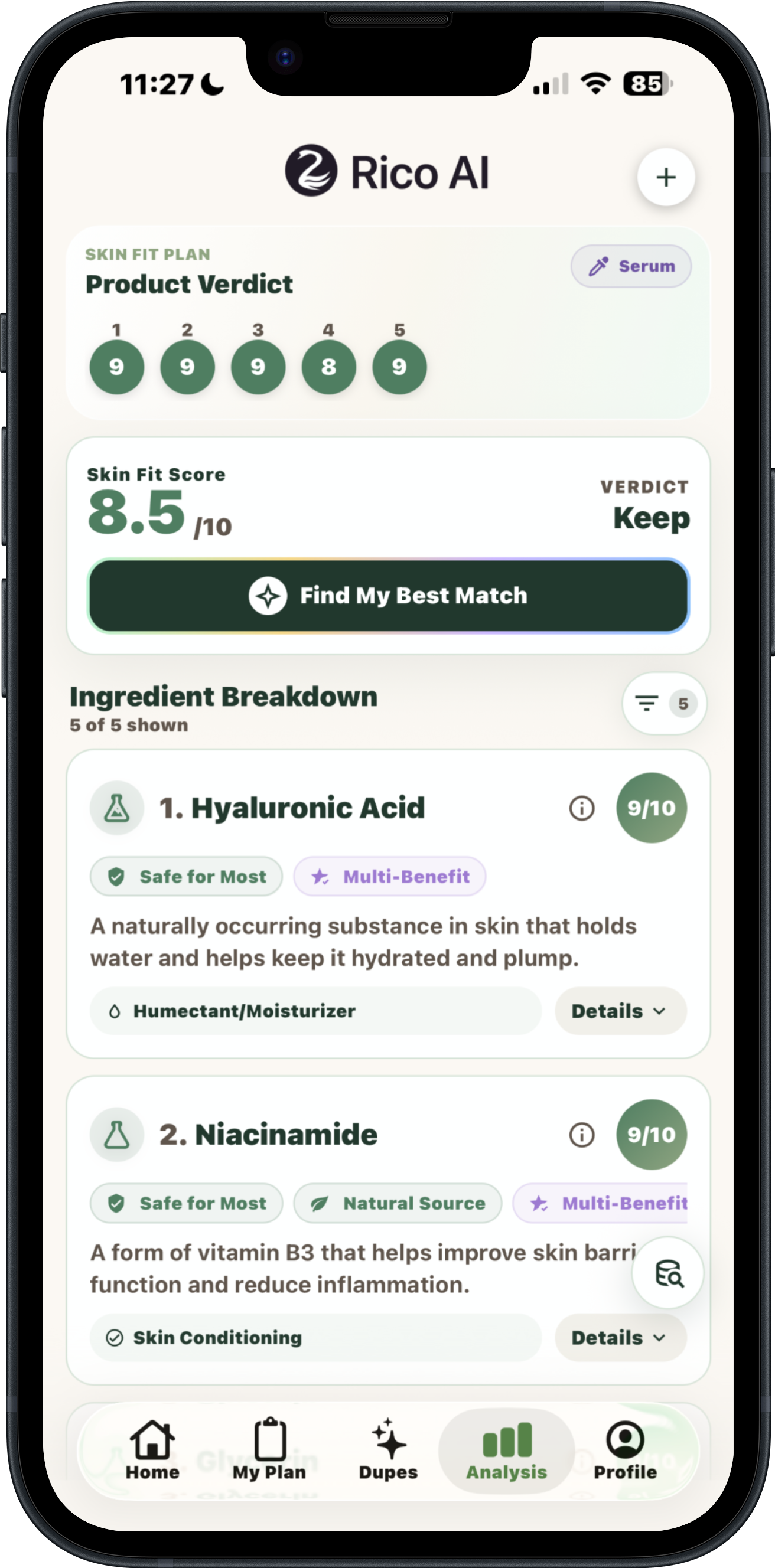
Free: Complete your first signed-in product check during onboarding and see Rico's plain-English Skin Fit result.
Sources and limits
These sources support the general guidance in this article. They cannot predict how one cosmetic will behave on your skin, and Rico does not diagnose or treat a skin condition.
- Tatcha US: Indigo Overnight Repair: full ingredients and directions. Checked November 3, 2026. Full ordered US declaration. Directions allow morning and night; Q&A describes nighttime as ideal. No SPF claim. Manufacturer selling the product; no independent layering trial.
- American Academy of Dermatology: Tips for relieving dry skin. Checked November 3, 2026. Creams and ointments, dimethicone and glycerin are options for dry skin; broad-spectrum water-resistant SPF30+ and other protection. General professional guidance, not an Indigo trial.
- American Academy of Dermatology: How to pick a moisturizer. Checked November 3, 2026. Ceramides support hydration; adapt moisturizer to dry areas and season. Professional education updated January25 2022; not finished-product proof.
- American Academy of Dermatology: Winter skin survival kit. Checked November 3, 2026. Moisturizer then sunscreen on top; broad-spectrum water-resistant SPF30+. Professional education updated May27 2021; no product compatibility test.
A note from Zee, Rico AI founder
Skincare shopping gets loud fast. I built Rico to help you slow down, read the product in front of you, and choose one next step without turning every ingredient into a warning.
Quick answers
Can Tatcha Indigo Overnight Repair work for daytime dry skin?
Yes, Tatcha Indigo Overnight Repair can be a daytime moisturizer for dry skin: its current directions allow morning use. The decision is whether its rich feel suits your sunscreen and makeup. Try it cautiously if you already tolerate it; keep sunscreen separate, and leave it for evenings if the layers feel heavy.
Why does the jar say overnight?
That is its positioning, and the brand Q&A still favors nighttime. Its current use directions also permit morning use; neither statement establishes your preferred daytime finish.
Can it replace sunscreen?
No. Keep sunscreen as a separate step and follow its directions.
Will it pill under foundation?
The ingredient list cannot predict your combination. Compare with familiar sunscreen and makeup; keep it for evenings if you dislike the layers.
Do I need another moisturizer underneath?
You do not need to add one just because this is called a serum-in-moisturizer. Decide whether the cream alone meets your comfort needs before adding more layers.
Built for a calmer product decision
Rico is your skin clarity coach for everyday skincare decisions: read or scan the label, understand the formula in plain language, and decide whether to buy, apply, compare, or skip. Rico gives educational Skin Fit guidance, not medical diagnosis or treatment.
Check one ingredient list free Check this product in Rico